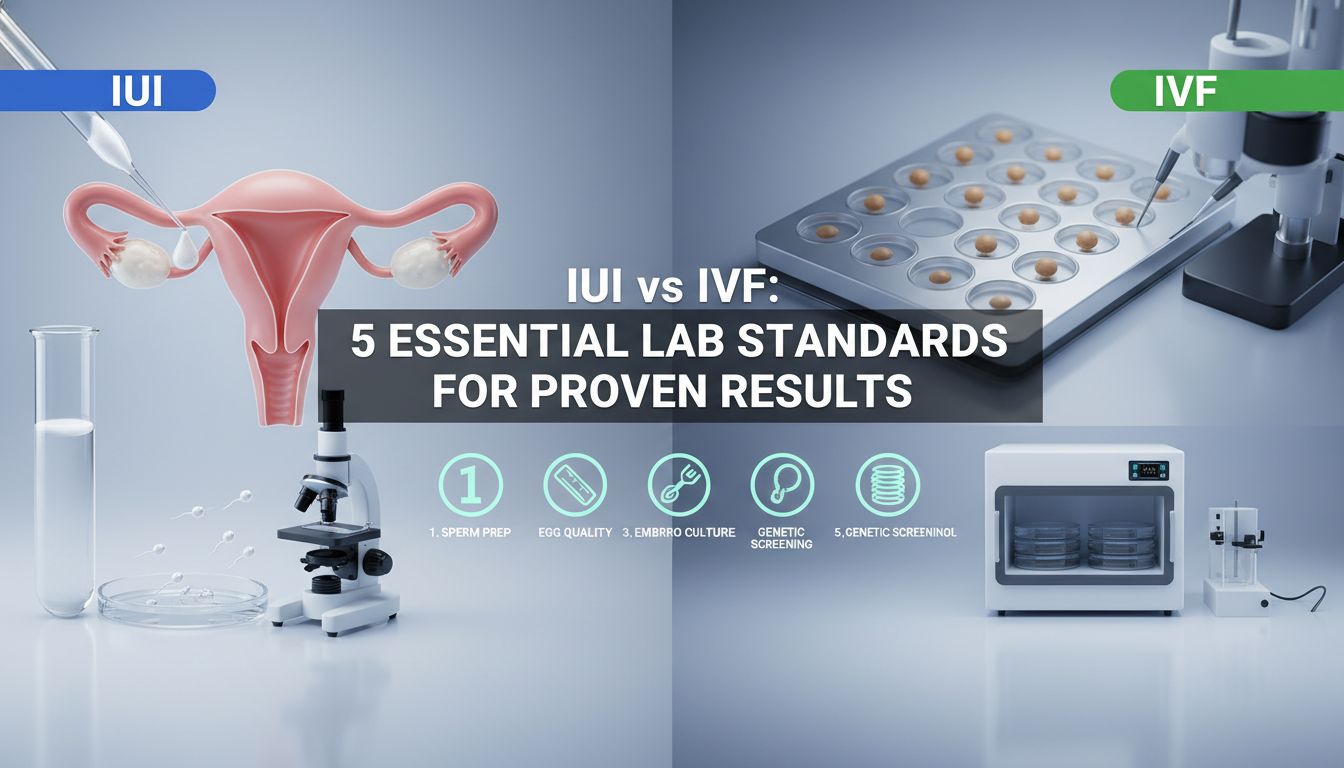
IUI vs IVF remains a critical topic for many couples in India. Understanding reproductive health is vital for every couple. This guide on IUI vs IVF is specifically tailored for gynecologist who wish to start iui clinic.
Table of Contents
- IUI vs IVF Lab Infrastructure: Creating the Ultimate Sterile Environment for Gamete Safety
- Proven Andrology Equipment: Essential Tools You Need to Maximize Conception Rates
- Standardizing Sperm Preparation: How to Achieve IVF-Grade Consistency in Your IUI Lab
- Essential Quality Control: Implementing Rigorous KPIs for Measurable Clinical Success
- The Ultimate Traceability Protocol: Eliminating Human Error in Your Growing Practice
IUI vs IVF Lab Infrastructure: Creating the Ultimate Sterile Environment for Gamete Safety
Defining the Scope: Infrastructure Requirements
When transitioning from general practice to specialized fertility care, understanding the infrastructure gap in IUI vs IVF setups is critical for proper resource allocation. While IVF laboratories demand stringent ISO Class 5 cleanroom environments, a high-quality IUI clinic can operate efficiently with a dedicated, sterile laminar flow station. However, regardless of the complexity difference in IUI vs IVF, cutting corners on sterility will inevitably compromise gamete integrity and success rates.
Air Quality and Contamination Control
Airborne volatile organic compounds (VOCs) and particulate matter are silent adversaries of sperm motility and gamete viability. In the IUI vs IVF context, IVF labs require complex HVAC systems with positive pressure and HEPA filtration, whereas IUI labs can achieve necessary safety levels with targeted air purifiers and strict zoning. For those planning a facility, reviewing our guide on IUI Lab Setup Cost: 7 Essential Tips to Save Big can help balance budget with safety.
Case Study: The Impact of Environmental Control
Patient Case A: A 32-year-old male with borderline asthenozoospermia experienced three failed IUI cycles in a clinic located near a high-traffic industrial zone without adequate air filtration. After the clinic upgraded its lab infrastructure to include medical-grade air purification and temperature stability, his post-wash motility retention improved by 15%.
The subsequent cycle, performed under these optimized conditions, resulted in a successful clinical pregnancy. This highlights that even in less invasive procedures, environmental factors play a pivotal role in outcomes.
Equipment Precision and Maintenance
The equipment inventory varies drastically when comparing IUI vs IVF requirements, yet precision remains non-negotiable for both. An IUI lab relies heavily on the accuracy of temperature control and centrifugation speed to prevent physical stress on sperm cells. Gynecologists should deepen their knowledge by reading Understanding the Role of Sperm Washing Centrifuge in IUI to select the right technology.
Adhering to Global Safety Standards
Regardless of the procedure’s complexity, adherence to global guidelines is mandatory for patient safety and legal compliance. The World Health Organization (WHO) provides extensive laboratory manuals that serve as the bedrock for sterile protocols in reproductive medicine. Implementing these standards ensures that the IUI vs IVF debate remains focused on clinical indication rather than safety compromises.
Case Study: Protocol Standardization
Patient Case B: A couple with unexplained infertility sought treatment at a newly registered clinic that strictly followed IVF-level sterility protocols for their IUI procedures. Previous attempts at a different center were marred by high bacterial contamination in the semen sample, likely due to improper handling.
By utilizing sterile, single-use consumables and a strict chain of custody, the new clinic eliminated contamination risks. The patient conceived within two cycles, proving that rigorous lab standards are vital for success.
Optimizing Workflow for Gamete Safety
Designing a lab requires a logical workflow that minimizes human error and exposure of samples to fluctuations in temperature or pH. While the operational flow differs in IUI vs IVF, the “chain of custody” for gametes must be watertight in both scenarios to prevent catastrophic mix-ups. This operational rigor is essential when converting OPD clinic into IUI clinic effectively.

Proven Andrology Equipment: Essential Tools You Need to Maximize Conception Rates
establishing High-Precision Standards in Andrology
Establishing a dedicated Andrology lab does not necessarily require the massive capital intensity associated with full embryology setups. However, the distinction between IUI vs IVF lab standards lies in the complexity of gamete manipulation, not in the quality of care provided. Precision instruments are non-negotiable for separating high-motility sperm effectively and ensuring high viability.
For a gynecologist starting an IUI practice, the priority must be equipment that minimizes physical and thermal stress on sperm cells. Unlike high-throughput diagnostic labs, a fertility-focused setup requires specialized centrifuges and visualization tools designed specifically for reproductive cells.
Core Equipment: Centrifuges and Workstations
A dedicated swing-out rotor centrifuge is vital for pelleting sperm without causing physical trauma or reducing motility. Unlike fixed-angle rotors, these devices ensure that the sperm pellet forms gently at the bottom of the tube, significantly minimizing resuspension errors. Clinicians can review Decoding Inconsistent RPM and RCF Output in IUI to understand why precise calibration impacts recovery rates.
When evaluating infrastructure for IUI vs IVF, remember that IUI relies heavily on the post-wash total motile count (TMC) delivered to the uterus. Therefore, your laminar flow hood and warmer stages must maintain physiological stability just as rigorously as in an IVF setting. Investing in a workstation with a heated surface prevents cold shock, a common cause of motility loss during processing.
Visualization and Analysis Tools
Phase-contrast microscopy is the gold standard for accurately assessing morphology and motility grading in your laboratory. Standard bright-field microscopes often fail to visualize the halo in viability testing or detect subtle morphological defects that hinder fertilization. Unlocking Semen Analysis: Key Insights for Male Fertility provides a deeper dive into optimal evaluation techniques for better diagnosis.
Adherence to global standards regarding equipment specifications is the bedrock of clinical success and patient safety. The WHO laboratory manual for the examination and processing of human semen outlines the exact requirements for equipment calibration and maintenance. Following these internationally recognized protocols ensures your clinic operates at a world-class level from day one.
Case Study 1: Impact of Centrifugation Protocols
Dr. A’s clinic initially utilized a general-purpose laboratory centrifuge, resulting in consistent post-wash motility rates below 30% for normozoospermic samples. After switching to an andrology-specific, temperature-controlled swing-out rotor system, the clinic reported a 25% increase in viable sperm recovery. This protocol adjustment directly contributed to three successful pregnancies within the first month of implementation.
Case Study 2: Optimizing Media Handling
A 32-year-old patient with mild male factor infertility underwent three failed cycles where significant sperm agglutination was noted post-processing. By integrating a dedicated workstation for media warming and using superior density gradients, as detailed in Understanding Gradient Media for Sperm Washing Techniques, the lab eliminated thermal shock. The subsequent cycle resulted in a viable clinical pregnancy and the delivery of a healthy infant.
Strategic Investment for Long-Term Growth
Selecting the right tools bridges the gap between basic care and high success rates in assisted reproduction. You can review our guide on IUI Lab Setup Cost: 7 Essential Tips to Save Big to prioritize your initial spending effectively. Ultimately, superior technology empowers you to treat male factor infertility with the confidence and precision your patients deserve.

Standardizing Sperm Preparation: How to Achieve IVF-Grade Consistency in Your IUI Lab
The Importance of Precision Protocols in Andrology
To establish a successful fertility practice, one must recognize that sperm preparation is not merely a wash; it is a critical enrichment process. When analyzing IUI vs IVF lab protocols, the standard for sperm handling in an IUI setting must remain equally rigorous to maximize conception rates. High-quality preparation ensures that only the most viable, morphologically normal sperm reach the uterine cavity.
Optimizing Centrifugation and Media Selection
Consistency in your laboratory depends heavily on the precise calibration of your equipment, particularly the centrifuge and incubators to maintain physiological conditions. Decoding inconsistent RPM and RCF output in IUI is vital to prevent iatrogenic damage to sperm, which is a frequently overlooked cause of cycle failure. Furthermore, selecting the correct gradient media is essential for effectively filtering out leukocytes and reactive oxygen species that compromise fertilization potential.
Case Study: Overcoming Recurrent Failure
Consider the case of Patient A, a 32-year-old with unexplained infertility who experienced three failed IUI cycles using standard washing techniques. By upgrading to a double-density gradient protocol typically reserved for IVF labs, we isolated a sperm fraction with superior motility and DNA integrity. This refined approach led to a confirmed clinical pregnancy in her subsequent cycle, highlighting the value of advanced processing.
Advanced Handling Techniques and Training
The gap in success rates often narrows when IUI samples are treated with the same delicacy and environmental control as IVF gametes. For clinics dealing with male factor issues, unleashing the power of advanced sperm wash techniques can significantly improve the total motile count (TMC) available for insemination. Continuous training ensures your laboratory staff can execute these precise maneuvers consistently.
Case Study: Management of Oligospermia
Patient B presented with mild oligospermia, a condition where many clinicians might prematurely suggest skipping IUI in favor of more invasive ART procedures. We implemented a specialized micro-volume wash protocol to minimize oxidative stress during processing, resulting in a highly concentrated, viable pellet. The couple successfully conceived via IUI, demonstrating that rigorous lab standards can effectively bridge the gap between treatment modalities.
Aligning with Global Benchmarks
Ultimately, the discussion of IUI vs IVF often centers on cost and complexity, but laboratory quality should never be the compromised variable. Adhering to global benchmarks, such as those outlined by the WHO laboratory manual for the examination and processing of human semen, ensures your clinic delivers top-tier care. By standardizing these variables, you offer your patients the highest probability of success within the IUI framework.

Essential Quality Control: Implementing Rigorous KPIs for Measurable Clinical Success
Establishing Clinical Benchmarks for Andrology Excellence
For a gynecologist establishing a new practice, the laboratory represents the heartbeat of clinical efficacy and patient trust. While the biological scope differs in IUI vs IVF procedures, the requirement for absolute precision in sperm handling remains a constant variable for success. We must move beyond basic microscopic evaluation to implement Key Performance Indicators (KPIs) that track recovery rates and post-wash motility rigorously.
One common misconception is that IUI laboratories require less stringent quality control than embryology labs. However, maximizing the potential of advanced sperm wash techniques is often the deciding factor in non-IVF conception. By standardizing these protocols, you ensure that every sample processed yields the highest possible functional sperm count.
Standardizing Equipment and Media Protocols
The calibration of your laboratory equipment directly correlates with the viability of the sperm sample post-processing. Issues such as inconsistent RPM and RCF output during centrifugation can cause irreversible cellular damage or poor pellet formation. Regular calibration checks ensure that the g-force exerted protects sperm integrity while effectively separating debris and leukocytes.
Furthermore, the choice of media plays a pivotal role in maintaining pH balance and osmotic pressure during the washing phase. Understanding gradient media for sperm washing allows the lab to tailor the approach based on the specific viscosity and count of the patient’s sample. Adhering to guidelines set by the World Health Organization (WHO) regarding laboratory manuals ensures that your clinic meets global safety and efficacy standards.
Clinical Case Study 1: Managing Severe Asthenozoospermia
Patient Profile: A 34-year-old male presented with a high sperm count but significantly reduced motility (15% progressive motility), creating a challenging prognosis. The couple had previously considered moving directly to IVF, but cost constraints prompted a final attempt at IUI.
Intervention & Outcome: We utilized a specialized double-density gradient wash to segregate highly motile sperm, strictly monitoring temperature to prevent thermal shock. This approach, focused on boosting IUI sperm motility, resulted in a final post-wash progressive motility of 85% in a 0.5ml volume. The patient’s partner conceived in the first cycle, demonstrating that rigorous lab technique can bridge the gap in male factor infertility cases.
Operational Efficiency and Cost Management
Implementing strict KPIs not only improves clinical outcomes but also streamlines the financial aspects of running a fertility center. Many clinicians worry about the IUI lab setup cost, but investing in quality control systems prevents wasted cycles and reputation damage. Efficient protocols reduce the consumption of expensive media and minimize the time technicians spend per sample without cutting corners.
When analyzing IUI vs IVF laboratory requirements, the IUI setup offers a lower barrier to entry but demands high proficiency in andrology. Monitoring metrics such as the “percentage of sperm recovered” helps in identifying technicians who may need retraining or equipment that requires servicing. This data-driven approach transforms a standard OPD clinic into a high-performance fertility center.
Clinical Case Study 2: PCOS and Timing Precision
Patient Profile: A 29-year-old female diagnosed with Polycystic Ovary Syndrome (PCOS) experienced irregular ovulation and two failed IUI attempts at a different facility. The previous failures were attributed to poor timing and varying sperm prep quality.
Intervention & Outcome: We adopted a comprehensive guide to PCOS treatment approach, synchronizing the insemination precisely 36 hours post-trigger shot with a fresh, rapid-wash sperm preparation. By minimizing the interval between liquefaction and insemination, we maximized sperm longevity within the uterine cavity. The patient achieved a clinical pregnancy in the second cycle, highlighting the importance of syncing clinical endocrinology with lab efficiency.
Final Thoughts on Laboratory Integrity
Ultimately, the success of your clinic depends on the reliability of the results your laboratory generates. Whether you are addressing male infertility causes or optimizing protocols for female factors, the data must be unassailable. Establishing these high standards early ensures scalable, consistent success for your practice.

The Ultimate Traceability Protocol: Eliminating Human Error in Your Growing Practice
As you transition your facility from a standard outpatient clinic to a specialized fertility center, establishing a fail-safe chain of custody is non-negotiable. Your professional reputation hinges on the absolute assurance that every biological sample is correctly matched to the corresponding patient throughout the entire treatment journey.
Many practitioners mistakenly believe that the rigorous identification protocols used in embryology are unnecessary for andrology, but this oversight exposes clinics to significant liability. When analyzing IUI vs IVF lab standards, the necessity for zero-tolerance regarding sample mismatch remains identical, regardless of the procedure’s complexity.
Implementing the ‘Four Eyes’ Principle
To eliminate human error, we recommend adopting the “double-witnessing” or “four eyes” protocol for every critical step of sperm preparation. This involves two staff members verbally and visually confirming the patient’s identity against the sample label before any processing occurs.
Adhering to global benchmarks, such as those outlined in the WHO laboratory manual for the examination and processing of human semen, ensures that your andrology protocols meet the highest safety criteria. You can further refine these operational standards by reviewing IVF Lab KPIs: 7 Proven Ways to Unlock Lab Excellence, which can be adapted for high-performance IUI setups.
Case Study: The Importance of Chain of Custody
Patient Profile: Mrs. Verma, 29, diagnosed with PCOS, and her husband, undergoing their second IUI cycle during a high-volume clinic day. The clinic handled ten samples within a two-hour window, increasing the theoretical risk of administrative errors.
Outcome: By utilizing color-coded labeling and a mandatory witness check at the centrifuge stage, the lab ensured the correct wash media was used for the husband’s specific viscosity profile. The precise handling resulted in a successful conception, highlighting how Complete Guide to PCOS Treatment and Fertility protocols rely heavily on lab organization.
Digital Integration and Labeling Standards
Modernizing your practice involves moving beyond handwritten labels to printed, water-resistant identifiers that withstand incubation and centrifugation. This digital approach creates an audit trail that is often lacking in smaller setups but is standard in advanced ART laboratories.
The debate of IUI vs IVF often centers on cost, but investing in a basic barcode system for your IUI lab significantly elevates your standard of care without the massive overhead of embryology equipment. For physicians looking to expand, understanding Male Infertility Causes: 7 Clinical Protocols to Scale Your IUI Clinic (2026) is essential for integrating these tech solutions effectively.
Case Study: Overcoming Severe Oligospermia through Precision
Patient Profile: Mr. Singh, 34, presented with severe oligospermia and high DNA fragmentation, requiring a specialized double-density gradient wash. The lab protocol required tracking specific processing times to prevent reactive oxygen species damage.
Outcome: A digital time-stamp system alerted the technician exactly when to halt centrifugation, preserving the limited viable sperm available. This meticulous traceability led to a viable pregnancy, demonstrating that treating Causes and Treatments for Low Sperm Count (Oligospermia) requires strict adherence to timing and identification.
By enforcing these traceability protocols, you bridge the gap between basic care and premium fertility services. Ultimately, whether a patient is researching IUI vs IVF, their decision will favor the provider who guarantees the highest safety and ethical standards.

Frequently Asked Questions on IUI vs IVF
What is the main difference in lab requirements for IUI compared to IVF?
IUI processing focuses primarily on sperm washing and concentration, whereas IVF requires a highly controlled embryology environment for fertilization. When considering IUI vs IVF, our lab maintains strict sterility protocols for both to ensure sample safety and viability.
Do you use the same sperm preparation standards for both procedures?
Yes, we apply rigorous quality control measures during sperm preparation regardless of the chosen treatment path. Understanding the biological nuances of IUI vs IVF allows us to tailor the preparation method to optimize fertilization potential for the specific procedure.
How does air quality affect the handling of samples?
Poor air quality can negatively impact gamete health, so we utilize advanced HEPA filtration systems in our andrology and embryology labs. While the duration of exposure differs in IUI vs IVF, ensuring a contaminant-free environment is crucial for both to maximize success rates.
How often is your lab equipment calibrated for safety?
We adhere to a strict daily and weekly maintenance schedule to ensure all incubators and centrifuges operate at peak performance. Reliability is key in IUI vs IVF, so we validate our equipment regularly to maintain precise temperature and pH levels.
Are your lab technicians specialized in handling samples for both treatments?
Our team consists of highly trained andrologists and embryologists who undergo continuous education in the latest reproductive technologies. Expert handling is essential in the debate of IUI vs IVF, ensuring that every sample receives top-tier care regardless of complexity.
How do you prevent sample mix-ups in the laboratory?
We utilize a rigorous double-witnessing system and electronic tagging to track every sample throughout the entire process. Whether a patient is undergoing IUI vs IVF, our chain-of-custody protocols guarantee that biological materials are correctly matched and secure.
Why is strict temperature control important during processing?
Sperm and eggs are highly sensitive to temperature fluctuations, which can damage their viability and overall motility. In both IUI vs IVF procedures, we use heated stages and precisely monitored incubators to mimic the human body’s internal environment.
What kind of culture media do you use for sperm washing?
We use high-grade, commercially tested culture media designed to support gamete survival and development during processing. The specific formulation may vary between IUI vs IVF, but all media lots are quality-tested for toxicity before use in our lab.
Does the quality of the laboratory affect treatment success rates?
Absolutely, as a pristine lab environment directly correlates with better sperm survival and embryo development. When comparing success rates of IUI vs IVF, the laboratory’s adherence to high standards is often a deciding factor in the clinical outcome.
Is your laboratory accredited by external regulatory agencies?
Yes, our facility is fully accredited and undergoes regular inspections to ensure compliance with strict national safety regulations. This external validation assures patients that our handling of IUI vs IVF cases meets or exceeds the highest industry standards.
How accurate is the initial semen analysis prior to treatment?
We use computer-aided sperm analysis (CASA) alongside manual verification to ensure precise data on count, motility, and morphology. Accurate diagnostics are vital for helping doctors recommend the best path between IUI vs IVF for each couple’s unique situation.
How does the lab handle cases with very low sperm counts?
For severe male factor infertility, we employ specialized concentration techniques or microsurgical retrieval methods to maximize recovery. Often, the severity of the count dictates the choice of IUI vs IVF, with IVF-ICSI being preferred for very low numbers.
What safety protocols are in place for biohazardous materials?
Our lab follows universal precautions, using personal protective equipment and specific disposal methods to prevent any cross-contamination. Safety is paramount in both IUI vs IVF workflows to protect our staff, our patients, and the integrity of the genetic material.
Can you freeze sperm for future use in either procedure?
Yes, we offer advanced cryopreservation services that allow sperm to be thawed and used effectively at a later date. This flexibility supports family planning whether the future treatment plan involves IUI vs IVF, ensuring the sperm remains viable.
Is the andrology lab maintained as a sterile clean room?
Our andrology section operates under clean room protocols to minimize dust, particles, and volatile organic compounds (VOCs). Maintaining these pristine conditions is critical for optimizing outcomes in both IUI vs IVF treatments by reducing environmental stress on cells.
Clinical Conclusion
Your path to building a family is supported by advanced science and clinical empathy at Subhag.in.
Medical Disclaimer: This information is for education. Always consult a Subhag medical expert for personalized advice.